

Over the last ten years I spent lots of time sitting in car parks and coffee shops.
Not by choice, but because school attendance had become impossible for our PDAer.

There's a photo of me in the driver's seat, smiling, in a bright red jumper that says 'Never Off Duty'. That car seat was my 'office' for a long time. That, or the nearest coffee shop if there was one - I wasn't fussy, as long as I could get back quickly if needed.
I've been thinking about those years a lot recently, mostly because of a short film called Unauthorised Absence, which is released online on Tuesday 10th November. (More on the film below, including the evening I went to the premiere!)
So I put together a little series of car and coffee shop photos for Instagram and Facebook. This post is the longer version of that story. There were a few villains along the way (I won't name names!), but really it's the story of a system that had no place for our PDAer, and me as a mum left waiting in the car park.
How did we end up in the car park?
Nine years ago, our younger daughter reached the point where she could no longer cope in mainstream school. She was 10.
It wasn't that she wouldn't attend, it was that she couldn't. If you know PDA, you'll know all about 'can't, not won't'. If you're newer to it, PDA (Pathological Demand Avoidance) is a profile of autism where everyday demands, even ones the person wants to meet, can trigger huge anxiety. I've explained more in my post Does my child have Pathological Demand Avoidance?
For the next few years, there would be a 'potted' school history. Some attempts at different types of school but mostly a lot of time spent at home with me.
At that point, she became a statistic. One more child counted in the figures for 'school attendance issues'. A number on a spreadsheet in an office somewhere, probably with a red flag next to it.
The thing about statistics is that they don't explain much about what's happening. They don't show the meetings, the phone calls, the forms or the hours spent on hold or composing emails. And they definitely don't show the mum in the car park.
What is EBSA?
There are lots of names for children who can't get into school. Some people call it school avoidance. Or school anxiety. Or EBSA, which stands for Emotionally Based School Avoidance.
To be fair, I understand why these terms exist, and EBSA could be considered slightly better than the old 'school refusal', which made it sound like a child was simply digging their heels in. The trouble is, they all seem to put the problem firmly with the child - it's the child who is 'avoiding', the child who is 'anxious'.
I would suggest two other acronyms:
- SINS: Setting Is Not Suitable
- LASP: Lack of Suitable Provision
They put the focus where it belongs, on the systems and the settings rather than on our children. Our girl wasn't avoiding school. There simply wasn't a school that suited her. As Dr Ross Greene says, kids do well if they can - and she couldn't, not in those places. (If you haven't come across his work, the Lives in the Balance website is well worth a look.)
If you'd rather listen than read, I talk about what EBSA meant for us in this video on my Facebook page.
(The pictures and book titles in this post contain affiliate links; as an Amazon Associate I earn from qualifying purchases but it won't cost you any extra)


Another book I'd recommend is Your Child is Not Broken by Heidi Mavir, a SEN advocate and parent who knows all about 'can't, not won't' first-hand. It's an honest, straight-talking read that makes it clear the struggles come from the environments and attitudes around our children, not from the children themselves. (Here's my full review of Your Child is Not Broken.)
The settings we tried
We didn't give up easily. Over the years, we tried:
- A special school
- A tutor service
- A supposedly more specialist, autism-specific school
- A specialist provision out of county
Each time, we hoped this would be the one. Each time, I sat nearby and waited. Just in case.
The autism-specific school deserves a special mention, though not a flattering one. On paper, it should have been the answer. In practice, the leadership team didn't understand PDA, or seem to want to support our girl in a way that worked for her. And as anyone who has tried strategies designed for other autistic children on a PDAer will know, what works for many can make things much worse for ours. Hindsight is a wonderful thing.
A Tribunal was fought (and I can't explain how sick that made me) and a new setting was 'awarded'. If you're facing Tribunal yourself, IPSEA is a brilliant place to start.
That new setting was a specialist provision out of county, and it was not our choice. But it was the decision, and we were expected to make it work. It didn't feel worth celebrating, and in fact overall a very small amount of learning time was given to our girl who had missed so much.
The car park years
The provision was an hour's drive away. Our girl attended sessions lasting an hour and a half, two or three times a week. Which, when you think about it, is a lot of driving for not much school. Two hours of driving for an hour and a half of education.
For over a year I found myself sitting in coffee shops a couple of times a week while she had a session or two. When it wasn't a coffee shop, it was a car park. Phone on my lap, just in case.
In fairness, I want to say that the staff at that provision were good. They helped her, and I'm genuinely grateful for that. But they could only offer limited time with our PDAer. It wasn't enough, and it was never going to be enough, not for a young person with her abilities and interests.
And all the while, I was a parent who couldn't really be anywhere else. I know so many parents and carers, mostly mums, who have had to step back from work or give it up altogether because the school day simply doesn't work for their child. The car park years have a cost that never shows up in any attendance figures.
A lot of trauma was rolled up in all of that, for all of us.
Post-16 provision? What provision?!
At 18, our girl was told she had to move on from that supportive setting. She was guided towards a mainstream college course (yes, I was there in the car park for that too), not because it was right for her, but because there was nothing else available that suited her skills.
It lasted six sessions. I can't say I was surprised. Disappointed, yes. Tired, definitely. But not surprised.
I am so glad she is now past the compulsory education stage. Because the pressure of attendance, the email admin, the meetings and the fight for a place that was never quite right, has finally lifted. The car park years are (hopefully) behind us.
I’ve been asked what our PDAer has been doing since. She recently published another animation on YouTube! All her skills are self-taught and of course I’m so proud of her. I’d love it if you could pop over, have a watch and maybe do a thumbs up if you like it - no comments necessary (or even welcomed, ha!) unless you know the subject matter.

Not an isolated story
As we were going through all this, I slowly began to realise that ours was not an isolated story. From writing my blog about PDA, I knew that sharing was a way to 'bring it all out in the open' rather than have it brushed under the carpet. So I began to share, some in the blog and some of it in our book. I still haven't told the full story; some of it went so deep beneath the surface it's hard to even think about it.

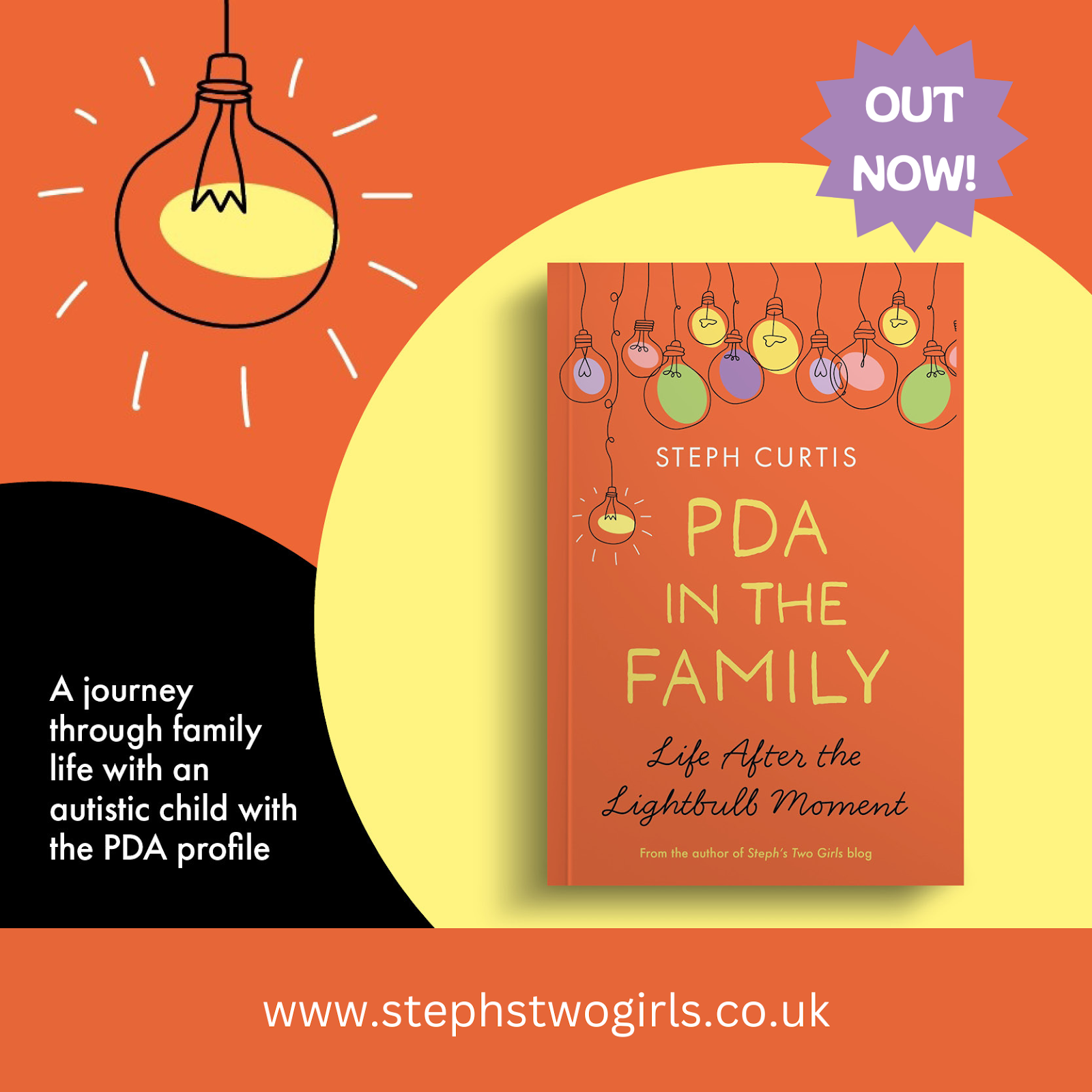
If you'd like the fuller picture, much more of our education story is told in our book, PDA in the Family: Life After the Lightbulb Moment. It goes into far more detail than I can here, along with what we learned along the way, and Mr C has written a chapter too.
In 2023 I ran a series on my blog called Not Fine In School (in conjunction with the fab website and Facebook group of the same name). The series gave other families the chance to tell their stories (anonymously or with names) about what education had looked like for their child/children and young adults.
There are 18 examples of how the education system has failed children and their families. Different ages and situations, some parents threatened with fines, some not but having to face the attendance battles anyway. One written by a speech and language therapist who also happens to be a mum, one by a 22 year old sharing her own experience of what it was like to be not fine in school.
These are the teeniest tiniest tip of the iceberg, I know. It somehow feels like the whole system and attendance situation is getting worse?
Maybe it's time to share some more of these real-life not fine in school stories? Please get in touch if you feel up to writing something about what has happened with you and your child that could be included as part of the next Not Fine In School blog series.
So what is Unauthorised Absence?
Unauthorised Absence is a short drama film, just under 16 minutes long, about a single mum, Anna, and her nine-year-old daughter, Thea. Thea is bright, sensitive and creative, stuck on a three-year waiting list for an autism assessment, and experiencing severe distress around school. By school, that distress is read as truancy or bad parenting. Anna is blamed, sent on parenting courses and eventually fined for her daughter's 'unauthorised absence'. (British Council)

The film was written by Jo Clayton, developed and produced by Natalie Lauren and directed by Georgia Parris. It was crowdfunded, which means it was helped to be made partly by people who have experience of these school issues. It's also Oscar-qualifying, and the cast is impressive: Emily Bruni plays Anna, Beatrice Flaherty plays Thea, Cathy Tyson is the headteacher and Anna Maxwell Martin (yes, Motherland's Anna Maxwell Martin!) is an executive producer.
It could not be more timely. According to the latest Department for Education figures, 492,825 penalty notices (fines) were issued to parents for unauthorised absence in England in the 2024/25 school year, up again on the year before. Around 32,000 were for 'other' unauthorised absences. My guess is a good number of them are families with SEND children like ours.
The premiere
Back in October, I was thrilled to be invited to the premiere. (I was a very last-minute addition to the list, if that makes anyone feel any better!) It is a masterpiece. Expertly created, produced, directed and acted, and I know it's going to resonate with so many families whose children have struggled with school. Tissues might be needed if this is the path you are walking...
It's already on the shortlist for some big awards, which matters. Not for the shiny trophies, but because the goal is for people who haven't lived this kind of school experience to watch it too, and begin to understand the stress it causes.
MP Chris Coghlan was at the premiere, and some other MPs (cross-party) were there the day before, when the No School Fines petition was handed in at Downing Street. We need more MPs to take notice. If you'd like some help writing a letter to yours, please get in touch with me.
I chatted with so many lovely people that evening, and was enjoying it far too much to take any photos of them (bar one shaky selfie). We may be smiling, but how sad is it that we've all had similar terrible experiences with the education system?

How to watch
The film is released on Tuesday 10th November:
- Online: free to stream on YouTube from 3:30pm, via Directors Notes and MIMESIC Films. Watch here.
- In person: community screenings are happening from 10th November. You can find one near you, or find out about hosting your own, on the film's page on the MIMESIC website.
A gentle word of warning: it's a powerful watch and not an easy one. The film is rated 12A, with content warnings for distressing scenes, threat and self-harm. Please look after yourself, and maybe don't watch it alone if you're having a tough week. If you need to talk, Samaritans are there 24/7 on 116 123.
Still happening today
"We know how difficult it can be for parents to receive another phone call from school, wondering what has happened, what they will be told and how they are going to help their child through whatever comes next. It is difficult to describe the emotional toll of trying to support a child who is struggling while feeling that the systems around you do not fully understand what they need.
These experiences can place enormous strain on the whole family. Parents may become increasingly fearful of interactions with professionals, trust can break down, and children may find themselves caught between the expectations of school and their parents' efforts to protect them from further distress."
These words are taken from an article written by Dr Natasha Holden.
It's a fair summary of what is still happening in schools today; a look at what is wrong with the system. It's not about blaming teachers or education staff. The goal should be to understand why school isn't working for so many children...
If you're in the car park right now
I see you. Maybe you're reading this on your phone in the driver's seat, cold coffee in the cup holder, waiting to find out whether today will be a good day or a phone-call day. I've been there, more times than I want to remember.
I don't have a magic wand, and I only know my own family. But I do know this: it is not your fault, and it is not your child's fault either. When a child can't attend school, the question isn't 'what's wrong with this child?' It's 'what's wrong with this setting?' Setting Is Not Suitable. Lack of Suitable Provision.
You are not alone. There's a whole community of parents and carers who understand, and some brilliant organisations too:
- PDA Society for information and support about PDA
- Not Fine in School for families of children struggling with attendance
- IPSEA for free, legally based advice on EHCPs and tribunals
- Define Fine and Special Needs Jungle for information and a wider community
Please do watch Unauthorised Absence on 10th November, and share it with anyone who still thinks attendance is just about parents trying harder. It might just change a mind or two. Watch this space :)
If you have any further questions, please feel free to ask in the comments. Comments are always very much appreciated!



No comments:
Post a Comment
Comments are always very much appreciated and can really help the conversation go further...